AI ADOPTION TO
PRODUCTION

Moving enterprise AI from
promising pilots to dependable
production systems

IT IS DESIGNED TO HELP ORGANISATIONS CROSS
THE HARDEST GAP IN ENTERPRISE AI: THE
TRANSITION FROM EXPERIMENTATION TO SYSTEMS
THAT ARE TRUSTED, GOVERNED, AND
OPERATIONALLY OWNED.

When this
solution applies

This solution is relevant when AI pilots have demonstrated value but production
rollout keeps slipping; when security, risk, or data concerns surface late and stall
progress; when ownership turns unclear once pilot teams step back; when
leadership remains hesitant to depend on AI outputs in real operations; and
when every new AI use case feels like starting over. In short, if AI activity exists
but confidence does not, this solution applies.

What typically
breaks today

In most organisations, AI does not fail dramatically - it stalls quietly. Pilots are
optimised for speed rather than operation, with temporary data access, informal
controls, and unclear accountability. Once early success is demonstrated,
unresolved questions around ownership, governance, and control prevent
systems from moving forward. The gap between demonstrated potential and
organisational trust continues to widen, leaving AI initiatives stuck between
promise and production.

What we take
responsibility for

[01] Defining production
readiness

We take responsibility for defining what “production‑ready AI” means in your
organisation - across reliability, risk tolerance, ownership, and control. This
creates a shared, practical standard agreed by engineering, security, risk, and
business stakeholders. By aligning expectations early, we prevent late‑stage
rework and conflicting interpretations that commonly derail AI initiatives just
before go‑live.
[02] Transitioning ownership
beyond pilots

We take responsibility for enabling the shift from pilot ownership to operational
ownership. This includes clarifying who owns outcomes, who approves
changes, and who responds when AI behaviour impacts the business. Without
this transition, AI systems remain experimental. Our role is to make ownership
explicit, durable, and accepted once systems move into live operation.

[03] Embedding governance into
the production path

We take responsibility for ensuring governance is built into the production
journey rather than added after pilots succeed. Security controls, data access
rules, policy enforcement, and auditability are designed into how the system
operates. This reduces friction with assurance teams and avoids late‑stage
blockers that commonly stall AI initiatives at the point of scale.

[04] Establishing observability and
control in live operation

We take responsibility for making AI systems observable once they are live -
including visibility into behaviour, quality, drift, usage, and cost. This enables
early detection of issues and timely intervention before trust erodes.
Observability is not about dashboards; it is about maintaining confidence in
AI‑driven decisions over time.

[05] Creating a repeatable path
to scale

Where required, we take responsibility for establishing repeatable production
patterns so future AI use cases move faster. This reduces reinvention, shortens
approval cycles, and builds organisational confidence incrementally - allowing
AI to scale as a capability rather than a series of isolated, high‑effort
deployments.

What changes when this is done well

Clear ownership of AI systems in production
Faster movement from pilot to live operation
Fewer governance and security surprises
Greater leadership confidence in AI outputs
A repeatable model for future AI use cases
CLIENT STORIES

What we have
seen in practice

Stabilising AI systems beyond the pilot phase Defining ownership and accountability for enterprise AI systems Embedding AI into existing enterprise workflows
REFERENCE ARCHITECTURES

Design that
support production

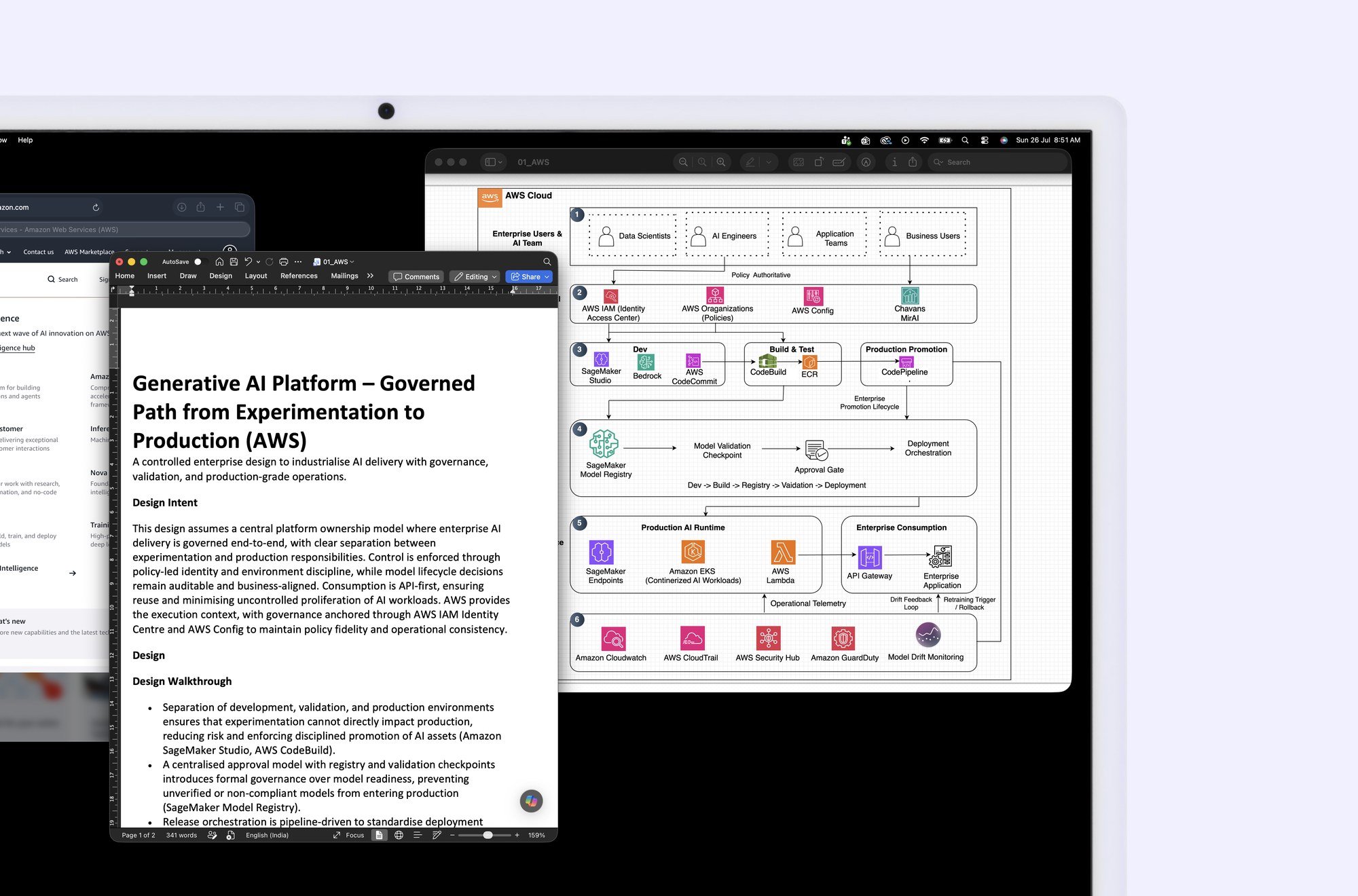
Generative AI Platform – Governed Path from Experimentation to Production (AWS): reference architecture document and diagram

AI systems that successfully move from pilot to production rely on a small set of
proven architectural patterns. These patterns focus on ownership, control, and
observability rather than model performance alone. Common approaches include
production‑grade deployment with approval flows, permission‑aware data access,
integrated security and policy enforcement, monitoring for behaviour and drift, and
controlled rollback mechanisms. Detailed reference architectures are available for
teams that require implementation depth.

We design production-ready AI systems to operate within existing cloud, data, and
security platforms, supported by our technology partnerships. View partnerships.

How engagements
start?

Engagements begin with structured working sessions, not
demos or proofs of concept. These sessions assess the
current state of AI initiatives, identify production readiness
gaps, clarify ownership and control requirements, and
define what must be true for AI systems to go live. The
objective is clarity before scale.

How this connects
to other solutions

AI Adoption to Production is often the first solution engaged
and acts as a bridge to longer‑term initiatives. It naturally
connects to AI Operating Model for lifecycle ownership,
Security & Responsible AI for embedded controls,
Enterprise Data & AI for production‑grade data foundations,
and GenAI & Agentic AI once autonomy and accountability
are clearly defined.

PERSPECTIVES

Related insights

[01] Enterprise AI fails not at build time,
but when no one owns it in production.
[02] Why most AI pilots never become
systems the business can depend on.

Start with clarity and context

A practical way to understand whether our approach fits your operating reality.

REQUEST AN INITIAL WORKING SESSION TALK TO A SPECIALIST