AI systems designed to operate inside real enterprise
FOR ORGANISATIONS WHERE SCALE, DATA, SECURITY, AND GOVERNANCE ARE NON-NEGOTIABLE.
The enterprise AI reality
Enterprise AI rarely fails because of the models themselves; it fails due to the surrounding realities of execution. Pilots often never survive the transition to production, data access remains fragmented and constrained by organisational boundaries, and security and risk considerations tend to enter too late in the process. At the same time, ownership of decisions is often unclear, while costs escalate faster than measurable value becomes visible. As AI moves from experimentation to operational use, enterprises begin to realise that the true challenge is not intelligence, but control, accountability, and integration. Applied AI is therefore not about proving what is possible - it is about ensuring that AI systems hold up consistently under real operating conditions.
What applied AI means to Chavans
At Chavans, Applied AI is not about deploying isolated AI tools or running standalone innovation initiatives. It is about designing and operating AI as a core enterprise capability, embedded within existing platforms, workflows, and business processes. These systems are built to respect data boundaries, governance policies, and permission structures, while operating within the realities of security, compliance, auditability, and financial accountability. They remain observable, controllable, and predictable in production, ensuring that AI contributes to better decisions, faster execution, and measurable business outcomes. We view AI as an operating capability that strengthens how the enterprise functions every day, not as a separate technology experiment. This distinction becomes critical as organisations scale and move from AI demonstrations to enterprise-wide adoption.
The four pillars of applied enterprise AI
[01] Enterprise data foundations
Applied AI is only as effective as the quality, trust, and governance of the data it can access. At Chavans, we enable secure, governed access to enterprise knowledge without centralising data ownership. Our approach connects information across domains while preserving permissions and access controls, ensuring retrieval and knowledge systems operate within governance boundaries. We focus on data lineage, metadata, auditability, and ongoing knowledge curation so enterprise information remains accurate, relevant, and trusted. The goal is not more data, but reliable, authorised information delivered in the right business context when it matters most.
[02] Security & responsible AI
At Chavans, security and responsibility are built into AI systems from the start, not added after deployment. Applied AI requires strong identity and access controls so models, agents, and users operate within defined permissions and governance boundaries. We focus on preventing data and prompt leakage, establishing guardrails for tool usage and privileged actions, and maintaining clear audit trails for decisions and interventions. This ensures AI remains secure, transparent, and accountable in enterprise environments. For us, Responsible AI is not a policy exercise; it is the operational discipline required to run AI safely, reliably, and at scale.
[03] GenAI & agentic patterns
Generative and agentic AI can deliver significant business value, but only when applied with clear intent and control. At Chavans, we help enterprises determine where agents enhance outcomes and where they may introduce unnecessary risk. This includes implementing human-in-the-loop approvals for high-impact actions, defining clear boundaries for agent permissions and behaviour, and preventing uncontrolled automation that leads to governance challenges and agent sprawl. The goal is not to maximise automation, but to deploy AI where it creates measurable impact while remaining secure, accountable, and aligned to business objectives. In Applied AI, judgement matters more than novelty.
[04] AI operating model
The hardest part of enterprise AI is not building systems, but operating them effectively at scale. At Chavans, we view Applied AI as an operational capability that requires clear ownership across product, platform, risk, and finance teams. Success depends on disciplined lifecycle management, from deployment and monitoring to optimisation and retirement, along with continuous evaluation of quality, performance, drift, and cost. Robust change controls and escalation mechanisms ensure systems remain reliable, governable, and aligned with business objectives. This operating discipline is what transforms AI from a successful pilot into a sustainable production capability.
Applied AI creates the greatest value when focused on a small number of business outcomes. At Chavans, we help organisations use AI to augment knowledge and decision-making, automate intelligent operations, build secure employee and customer copilots, strengthen risk and compliance processes, and accelerate application modernisation and testing. The objective is not to increase the visibility of AI within the enterprise, but to deliver measurable improvements in productivity, efficiency, governance, and business performance. In Applied AI, outcomes matter more than AI presence.
REFERENCE ARCHITECTURES
Design that survive production
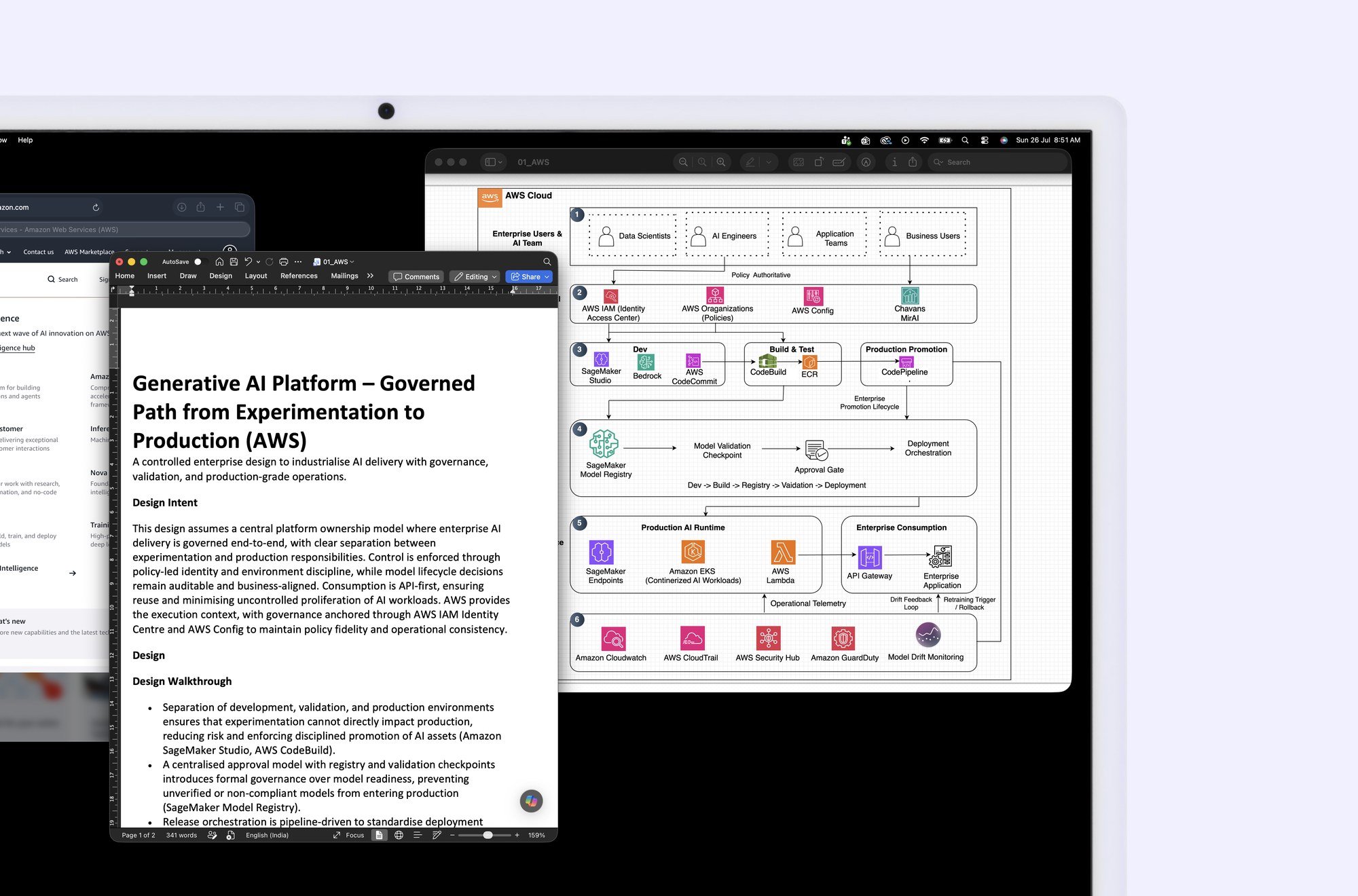
Applied ai is grounded in proven architectural patterns that have been validated through real enterprise use. these include enterprise rag implementations with permission-aware access, agent orchestration models supported by policy and approval layers, and human-in-the-loop approval flows for high-risk actions. equally important are observability and evaluation pipelines that continuously monitor and assess ai system performance. these patterns are not theoretical constructs but are refined through practical deployments in live environments, with more detailed implementations captured in formal Reference architectures.
We design applied ai systems to operate within existing cloud, data, and security platforms, supported by our Technology partnerships.
How engagements start?
Applied AI engagements do not begin with demos; they begin with structured working sessions that bring clarity and direction. These sessions are designed to assess organisational readiness and risk, identify where AI should - and should not - be applied, define governance frameworks and operating boundaries, and prioritise use cases grounded in enterprise reality. This disciplined approach ensures that decisions are made with context and intent, creating clarity before any commitment is made.