
AGENTIC WORKFLOW AUTOMATION (WITH GUARDRAILS)

Automating enterprise workflows without surrendering control or accountability

Agentic Workflow Automation (with Guardrails) is designed to help organisations automate high-value workflows using AI agents — while keeping authority, accountability, and oversight firmly in place.

When this
solution applies

This solution applies when:

What typically
breaks today

Most agentic automation initiatives fail not because agents are ineffective, but because boundaries are unclear. Agents are given broad access, operate without sufficient oversight, or lack clear escalation paths. As autonomy increases, so does discomfort across security, risk, and operations teams. The result is stalled rollouts, over-restricted automation, or systems that work only under ideal conditions but fail under real enterprise complexity.

What we take
responsibility for

[01] Defining where autonomy is appropriate

We take responsibility for determining where agentic autonomy adds value — and where it introduces unacceptable risk. This includes assessing workflows for reversibility, impact, and dependency, and defining clear boundaries for automated versus human-approved actions. By establishing these limits upfront, we prevent over-automation and build confidence in agent-driven execution.


[02] Designing guardrails into agent behaviour

We take responsibility for embedding guardrails directly into how agents operate. This includes scoped permissions, policy-driven constraints, approval checkpoints, and explicit escalation paths. Guardrails ensure agents act only within defined authority, reducing the risk of unintended actions while preserving the benefits of automation.

[03] Maintaining human accountability in automated workflows

We take responsibility for ensuring that human accountability is preserved even as automation increases. This means designing workflows where responsibility for outcomes remains clear, actions are attributable, and intervention is always possible. Automation accelerates execution — it does not remove ownership.

[04] Ensuring observability and intervention capability

We take responsibility for making agent behaviour observable in production. This includes visibility into decisions, actions, failures, and exceptions. Observability enables teams to intervene early, adjust behaviour, and maintain trust in automated workflows as conditions evolve.

[05] Scaling automation without increasing risk exposure

Where required, we take responsibility for establishing patterns that allow agentic automation to scale safely. This prevents each new automated workflow from reopening governance debates, enabling enterprises to expand automation with confidence rather than caution.

What changes when this is done well

Workflows move faster while authority and oversight remain intact.

Teams are willing to rely on agents because behaviour is constrained and observable.

Humans intervene where it matters, not everywhere.

Responsibility for outcomes remains explicit even as automation scales.

New workflows adopt agentic patterns without re-negotiating governance each time.

CLIENT STORIES

What we have
seen in practice

Designing agentic AI systems with human oversight Preventing unintended actions in agent‑driven enterprise systems Introducing guardrails for GenAI in enterprise workflows
REFERENCE ARCHITECTURES

Design that
support production

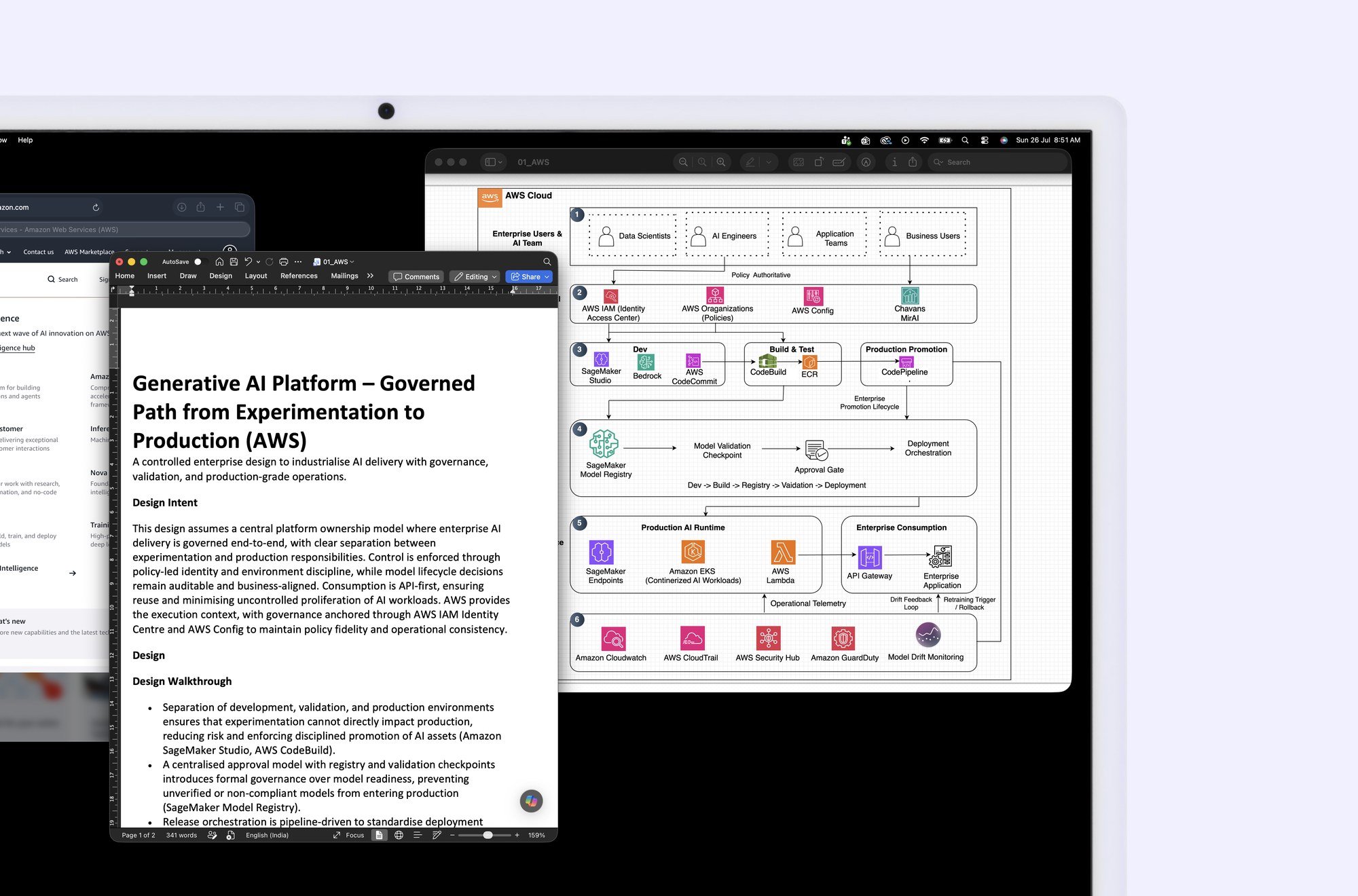
Generative AI Platform – Governed Path from Experimentation to Production (AWS): reference architecture document and diagram

Agentic workflow automation relies on proven architectural patterns that combine autonomy with control. These include agent orchestration frameworks with scoped permissions, policy-enforced action layers, human-approval checkpoints for high-impact actions, and monitoring pipelines for behaviour and exceptions. Together, these patterns ensure agentic automation remains production-ready and governable at enterprise scale. View Reference Architectures

We design production-ready AI systems to operate within existing cloud, data, and security platforms, supported by our technology partnerships. View Partnerships

How engagements
start?

Engagements begin with structured working sessions focused on identifying suitable workflows, defining acceptable autonomy, and designing guardrails. These sessions clarify risk tolerance, approval requirements, and escalation paths before automation is introduced. The objective is to automate deliberately — not experimentally.

How this connects
to other solutions

Agentic Workflow Automation commonly builds on AI Adoption to Production and connects closely with Security & Responsible AI for guardrails, Enterprise Data & AI for permission-aware access, and AI Operating Model to ensure long-term ownership and control. Together, these solutions allow automation to scale responsibly.

PERSPECTIVES

Related insights

[01] Agentic AI Fails When Autonomy Is Introduced Without Accountability [02] Why Enterprise Automation Breaks Without Clear Human Oversight

Start with clarity and context

A practical way to understand whether our approach fits your operating reality.

REQUEST AN INITIAL WORKING SESSION TALK TO A SPECIALIST