AI-READY DATA FOUNDATIONS & UNIFICATION

Making enterprise data usable for AI - without breaking governance or creating parallel stacks

AI-Ready Data Foundations & Unification is designed to help organisations make existing enterprise data usable for AI — safely, permission-aware, and at scale.

When this
solution applies

This solution applies when:

What typically
breaks today

Most enterprises do not lack data — they lack trusted, governed access to data. Data exists across applications, domains, and platforms, but ownership, permissions, lineage, and context are inconsistent. In response, teams duplicate datasets, build point pipelines, and create siloed “AI views” that bypass governance. Over time, this erodes trust, increases risk, and makes AI outputs difficult to explain or defend. The issue is not volume — it is access, accountability, and confidence.

What we take
responsibility for

[01] Establishing AI-ready data foundations

We take responsibility for ensuring that core enterprise data is reliable, governed, and usable for AI. This includes improving data trust where it matters most, clarifying ownership, and reducing duplication that silently increases risk and cost. The objective is not perfect data, but data that can be confidently used in production AI systems.


[02] Unifying data access without centralising ownership

We take responsibility for enabling a coherent view of enterprise data without forcing centralisation. This means designing access patterns that respect domain ownership, permissions, and business context, while allowing AI and analytics systems to retrieve the information they need. Unification is achieved through access and governance — not by moving everything into a single platform.

[03] Designing permission-aware data for AI use

We take responsibility for ensuring that data accessed by AI systems respects enterprise permissions and policies. This includes designing retrieval, augmentation, and knowledge access patterns that prevent unintended exposure while maintaining traceability. AI outputs must be explainable and auditable — not just accurate.

[04] Embedding data governance into daily operation

We take responsibility for making data governance an operational discipline rather than an after-the-fact review. Lineage, metadata, access controls, and audit evidence are designed into how data is accessed and used. This allows teams to move faster with confidence instead of slowing down under repeated reviews.

[05] Reducing data friction for future AI initiatives

Where required, we take responsibility for establishing repeatable data patterns that reduce friction for future AI use cases. This prevents each new initiative from reopening access debates, data readiness discussions, and governance concerns — allowing AI adoption to compound rather than reset.

What changes when this is done well

Teams and leaders can rely on AI outputs because data sources and access are transparent.

Parallel AI datasets give way to governed access patterns.

Permissions, ownership, and access are addressed upfront.

Data decisions are aligned rather than contested.

New AI use cases build on existing data patterns instead of starting over.

CLIENT STORIES

What we have
seen in practice

Making enterprise data usable for AI at scale Introducing governance without slowing AI innovation Ensuring data quality and lineage for production AI systems
REFERENCE ARCHITECTURES

Design that
support production

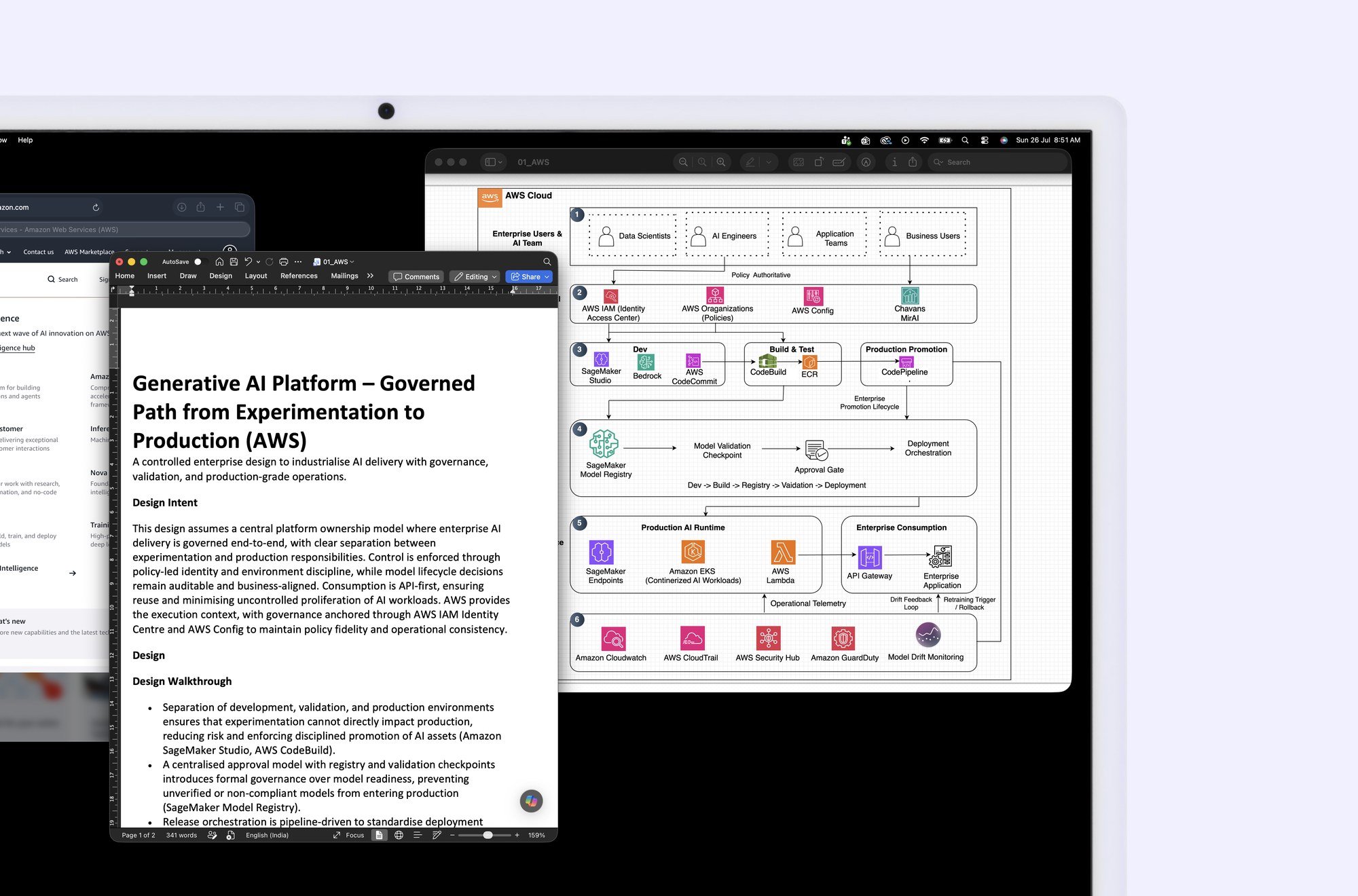
Generative AI Platform – Governed Path from Experimentation to Production (AWS): reference architecture document and diagram

AI-ready data foundations rely on proven architectural patterns that balance access and governance. These include domain-based data foundations, permission-aware retrieval architectures, metadata and lineage pipelines, and observability for data reliability. Together, these patterns ensure AI systems can operate on enterprise data safely and consistently — without creating parallel stacks. View Reference Architectures

We design production-ready AI systems to operate within existing cloud, data, and security platforms, supported by our technology partnerships. View Partnerships

How engagements
start?

Engagements begin with structured working sessions focused on understanding current data realities, ownership boundaries, and AI requirements. These sessions identify where trust breaks down, how access should be designed, and which changes will deliver the biggest reduction in AI friction and risk. The objective is clarity before transformation.

How this connects
to other solutions

AI-Ready Data Foundations & Unification underpins almost every other Solution. It connects closely with AI Adoption to Production, Agentic Workflow Automation, Security & Responsible AI, and AI Operating Model, ensuring that AI initiatives are built on data that can be trusted and governed in production.

PERSPECTIVES

Related insights

[01] Enterprise AI Fails Where Data Trust Is Assumed, Not Designed [02] Why Unifying Enterprise Data Is an Access Problem, Not a Platform Problem

Start with clarity and context

A practical way to understand whether our approach fits your operating reality.

REQUEST AN INITIAL WORKING SESSION TALK TO A SPECIALIST